You cannot verify where a stranger's money came from, and no amount of care changes that. What you can do is reduce how much of your life is exposed when it goes wrong, keep evidence that survives questioning, and know the order to act in. This page is about those three things, not about eliminating a risk that cannot be eliminated.
Lowering the odds
- Why the receiving end is the exposed one
- Restrictions come in different kinds
- Beforehand: how to arrange accounts
- During: how to trade
- Evidence, and what makes it useful
- If it happens, the order matters
- Four widely repeated claims that do not hold
- A more useful way to think about it
- Things not to do, ever
Why the receiving end is the exposed one
Buying crypto means sending money to a counterparty. Selling means receiving money from one. Those are not mirror images.
When you receive, the funds arrive with a history you cannot see. If any part of that history is under investigation, the investigation follows the money forward. Through accounts that merely handled it, including yours. Nobody is accusing you of anything at that point. The account is still restricted while it gets sorted out.
That is the structural fact. Everything below follows from it.
Restrictions come in different kinds
Getting this wrong wastes the days that matter most, so establish it first.
| Kind | How to recognise it | Who resolves it |
|---|---|---|
| Bank internal control | The bank's own wording — verification, temporary limit — with no authority named | The bank, usually with documentation |
| Legal process | The notice names an investigating body or references a case | That body. The bank is only executing it. |
| Platform-side restriction | Limits inside the exchange account, not the bank | Platform support |
Look at the notice before you do anything. Read it for whether an authority is named. Then act accordingly. Arguing with a bank about something a court ordered is a way to spend a week going nowhere.
Beforehand: how to arrange accounts
Use an account you could afford to lose
Not the salary account. Not the one the mortgage comes out of. A restriction on those disrupts your life in ways that are wildly out of proportion to the convenience of using them.
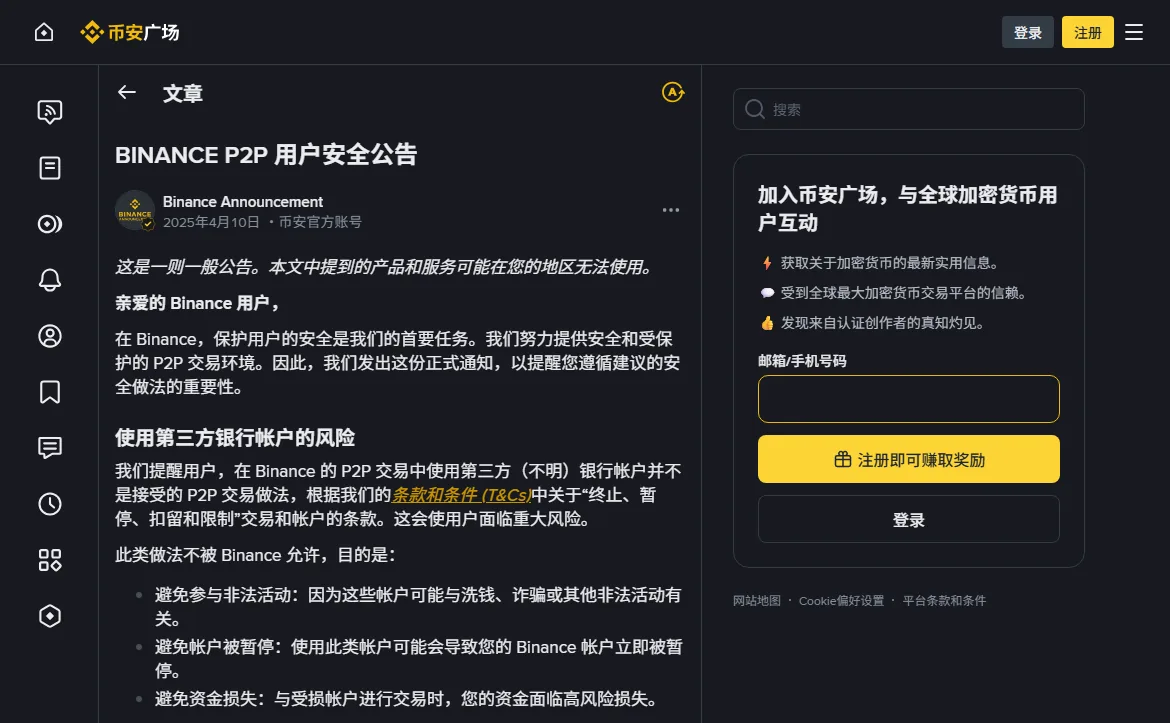
Worth being clear that this is not our inference — the platform states it. The P2P user safety notice asks that you receive only into a bank account opened in your own name. Taking payment through someone else's card risks more than being cheated; it puts your exchange account itself in line for suspension. So the "dedicated account" above always assumes the account is yours to begin with.
Give that account a normal life
An account that exists only to receive P2P payments looks exactly like what it is. One with ordinary traffic — some regular incoming, some spending, an existing history — does not stand out in the same way. This is not a trick; it is the difference between an account you use and an account you set up for one purpose.
Keep amounts in proportion
An account that normally sees modest sums receiving something far larger is the single most reliable way to trigger a review. Scale the trades to the account, or use an account whose normal activity matches the trades.
During: how to trade
- Stay on the platform. Every protection you have comes from the trade existing inside the escrow system.
- Prefer counterparties with long histories and high completion rates. It is weak evidence, but it is the evidence available.
- Do not trade repeatedly with the same counterparty. Repetition builds a pattern, and patterns are what monitoring is built to find.
- Do not run many trades in a short window.
- Refuse anything unusual. Split payments from multiple accounts, a third party paying "on behalf of" the buyer, a request to settle outside the platform — all of these are reasons to cancel, and none of them is worth the price improvement offered.
That last one deserves emphasis. Almost every account-freezing story that starts with "the price was a bit better" also contains a moment where something felt irregular and the trade continued anyway.
Evidence, and what makes it useful
Keep, for every trade: the order screenshot including the order number, both parties' identifiers, the amount and the timestamp; the bank's own record of the incoming payment; and the platform's transaction history export.
Two things make evidence actually useful rather than merely present. It should be contemporaneous. Captured at the time, not reconstructed later. And it should be complete for the whole chain: where the crypto came from, when it was sold, what arrived. A record of the final payment alone does not answer the question anyone will ask.
Keep it somewhere the account restriction cannot reach. Records stored only in the app of a frozen account are records you cannot produce.
If it happens, the order matters
- Stop trading immediately. Continuing while one payment is under question turns one problem into several.
- Work out which kind of restriction it is, using the notice.
- Gather the evidence for the specific transaction, not everything you have.
- Contact the right party. The bank for an internal control; the named authority for a legal process. In the second case, cooperate — being the last honest link in a chain is a normal outcome and is resolved by showing what you did.
- Consider professional help if an authority is involved and the amount is significant. That is a real legal process, and this page is not a substitute for advice about it.
Four widely repeated claims that do not hold
"Smaller banks are safer"
Anti-money-laundering obligations apply across the board. Smaller institutions sometimes have less automated screening, which means the problem surfaces later. Not that it does not surface. Later is usually worse, because more transactions have accumulated by then.
"Small amounts are fine"
Amount affects the probability of attention, not whether funds can be traced. A small payment that happens to sit in a chain under investigation gets the same treatment as a large one.
"Trading with people you know removes the risk"
Your counterparty being trustworthy says nothing about where their money came from. They may not know either. The risk is upstream of both of you.
"You can pay your way out of it"
Anyone offering to unfreeze an account for a fee is running a second fraud on someone who has already had a bad week. There is no such service — the FTC's consumer guidance describes this exact pattern.
A more useful way to think about it
Not "is this safe". Nothing here is binary. Three questions instead:
- If this account were frozen for three months, what breaks?
- If someone asked me to explain this payment, could I, with documents?
- Am I doing anything here that I would struggle to describe plainly?
Comfortable answers to all three mean the exposure is managed. An uncomfortable answer to any of them tells you which one to fix.
Things not to do, ever
- Do not receive payment on behalf of someone else, whatever the explanation.
- Do not lend or rent an account to anyone. This ends badly and reliably.
- Do not accept payments from accounts unrelated to your counterparty.
- Do not believe anyone who says they can guarantee funds are clean. Nobody can.
- Do not trust the phrase "zero risk", including from us. What we can offer is ways to lower the probability. Not a guarantee.
One last thing. If you have read this far and concluded the exposure is more than you want, not doing it is a perfectly sound answer. The Hong Kong route has a different risk shape, set out in buying USDT with HKD via FPS; the rest of the cash-out chain is in cashing USDT back to a bank account. What your own jurisdiction permits is decided by local law, and this site publishes no way around it — see the risk notice.