Hong Kong's Faster Payment System settles in seconds, around the clock. It is operated under the Hong Kong Monetary Authority and its own official site sets out what it does. On a peer-to-peer trade that removes the longest source of anxiety. The wait between sending money and the crypto being released. It also sharpens a different problem, because a transfer that clears instantly still carries a reference field, and that field is read.
The mechanics are the same as any other P2P route: the exchange holds the crypto in escrow, you and the counterparty move the money directly. What changes is the texture of each step.
What you need before starting
Two things, and both have to be true at once: an account at a Hong Kong bank or a licensed stored-value operator, and a name on that account matching the verified name on your exchange account. No exceptions on the second one — a mismatch gives the counterparty a legitimate reason to refuse release.
Worth checking in advance rather than mid-trade: some stored-value wallets cap daily transfers at a level well below what you might want to trade, and the cap is not always where you would expect to find it in the app.
This route comes with a ruler
The advice on picking a merchant is to look at price last. That holds, but it sidesteps a more practical question: how do you know the quote in front of you is already expensive?
On the renminbi route that question is hard to answer. The renminbi floats against the dollar, so there is no official figure for what the over-the-counter price ought to be. Compare a few merchants and you learn which one is cheaper. You do not learn whether any of them is dear.
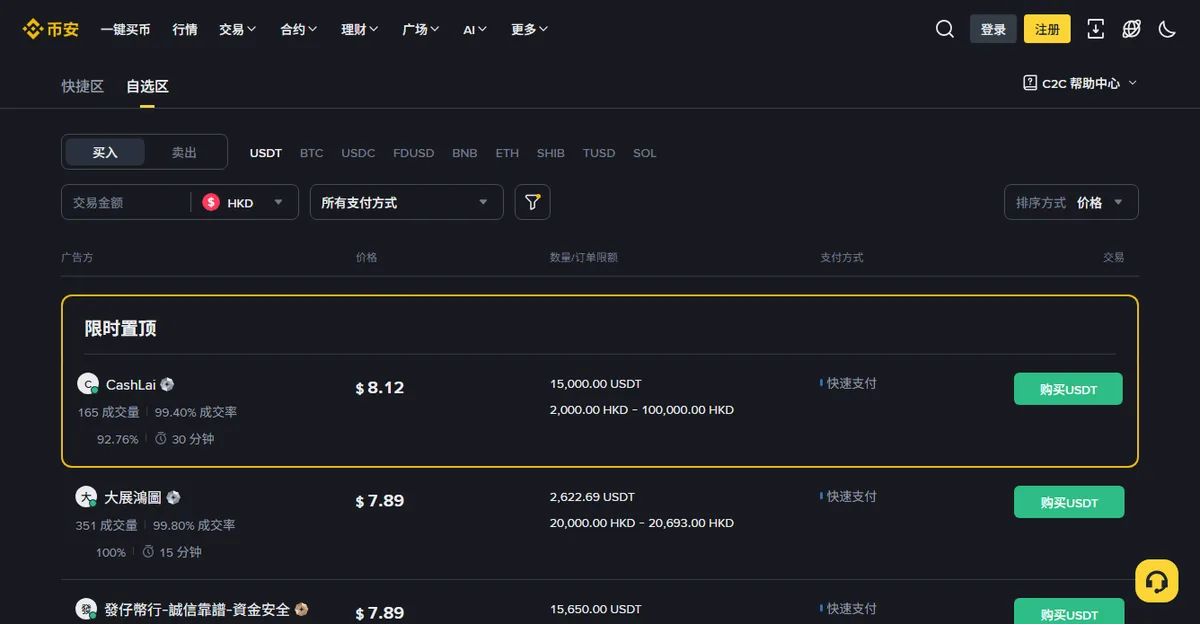
Hong Kong is different. The currency is pegged, not floating — the Hong Kong Monetary Authority runs the Linked Exchange Rate System, in place since 17 October 1983, which today holds it within a band of 7.75 to 7.85 to one US dollar (per the HKMA page, checked September 2026). USDT, meanwhile, is a token pegged to the dollar. Put the two together and you are holding a ruler the renminbi side does not have: a quote that is not taking advantage of you should sit close to that band.
Using it is one division. Take the merchant quote, divide by 7.8 — the middle of the band — and subtract one. What is left is the share you are paying on top of the exchange rate itself. A quote of 7.85 comes out around 0.6% over. A quote of 8.10 comes out around 3.8%. The second number looks small until you put it against a transfer of any real size.
Two conditions, or the ruler gets used wrongly:
- USDT is not the dollar. It is pegged to it and still drifts a little, more visibly when markets are tense. What you are measuring is a zone, not a precise figure.
- Merchants take a spread, and sitting near the top of the band is normal. The point is to filter out the clearly expensive ones, not to go bargaining. Chasing a fraction of a percent to a merchant with barely any completed trades is the wrong trade to make.
One more thing worth knowing going in: FPS runs around the clock. Weekends, public holidays, the middle of the night — none of that stops the transfer itself. The system was launched by the Monetary Authority in 2018 and is operated by Hong Kong Interbank Clearing Limited, settling in real time at all hours.
The rails not resting does not mean the people do. What usually decides how long you wait is whether the merchant is awake. Place an order late on a Sunday and the money may land in seconds while the release sits untouched until someone gets up. The coin is locked in escrow that entire time and is not going anywhere; you are simply waiting. Which is why, outside office hours, that "average release time" column matters more than price.
And one thing people mix up: FPS itself carries both Hong Kong dollars and renminbi, but that does not mean you can ride it into the renminbi route. Which payment methods an over-the-counter channel accepts is set by the exchange and the merchants on it, which is a separate question from what the payment system is capable of carrying.
How the trade actually runs
Same skeleton as any escrow trade — the exchange freezes the seller's crypto, you pay, they release — but each step feels different here.
| Step | How it behaves on this route |
|---|---|
| Sending payment | Seconds, at any hour. No cut-off times, no weekend gap. |
| Confirmation | The counterparty sees it almost immediately, so release tends to follow quickly. |
| Order window | Short. That is fine when payment is instant, and a problem if you open an order before you are ready to pay. |
| Reference field | Travels with the payment and is visible to the receiving institution. This is the field that causes trouble. |
The reference field
Leave it empty where the app allows it. Where something is required, write something ordinary and unrelated.
What not to put in it: any crypto-related term, any exchange name, any ticker, any abbreviation that resolves to one. Banks do not publish how their screening reads the reference field, so you cannot know in advance how such a word will be treated; leaving it out avoids the question, and a flagged transfer is your problem to resolve, not the counterparty's.
Instant settlement makes this matter more rather than less. There is no clearing window in which something might be caught and quietly reversed. The payment lands, and if it is going to attract attention, it does so with the money already delivered.
Bank account or stored-value wallet
Both work. They fail differently.
- Bank account. Higher limits, better suited to larger amounts, and the more common choice among merchants. The downside is that a bank's controls are stricter, and a restriction on a bank account is more disruptive to the rest of your life.
- Stored-value wallet. Convenient, quick to open, and lower stakes if something goes wrong. Limits are tighter and not every counterparty accepts them.
Either way the account name must match your verified identity. That constraint does not bend.
Thin books and larger amounts
The HKD book is not as deep as the largest currency pairs. For everyday amounts you will not notice. Above that, you have three options and none of them is free.
Split the trade across several counterparties, accept a worse price to fill in one go, or wait for better listings to appear. Which is right depends on whether you are more exposed to price movement or to the hassle of multiple orders.
One habit worth having: check the depth before you decide on an amount, not after. Discovering the book is thin while you already have an order open is how people end up accepting a price they would otherwise have refused.
Going the other way
Selling into HKD inherits the same speed and the same reference-field caution, but the risk profile flips. When you are receiving, you cannot verify where the incoming funds came from, and that exposure is structural rather than something care can eliminate.
The full treatment of the receiving side — how to arrange accounts, what evidence to keep, what order to do things in if a payment is queried — is in selling crypto for cash. Cashing out to a bank account more generally, including timing and costs, is in cashing USDT back to a bank account.
Three places it commonly stalls
| Where it stops | Usual cause | What to do |
|---|---|---|
| Payment sent, crypto not released | Counterparty slow or inattentive | Mark as paid in the interface, wait a reasonable interval, then open a dispute with the payment record attached |
| Transfer rejected by the bank | Limits, or the reference field | Check the limit first; if it was the reference, that is a lesson rather than a fix |
| Name mismatch | Paying from an account in someone else's name | Cannot be argued around. Pay from your own account. |
Three ways this differs from other P2P routes
- Speed. Instant settlement removes the waiting, which removes most of the disputes that come from waiting.
- Depth. Thinner book, so larger amounts need planning rather than just clicking.
- Where the risk sits. On this route the exposure is mostly about how your own account behaves. On routes where you are receiving from strangers, it is about the counterparty's funds, which is a harder problem.
One difference sits outside the mechanics: whether you can move the coins out straight after buying. The yuan route carries a 24-hour hold above an allowance; HKD, as checked in September 2026, is not on that list — the detail is in the piece on the T+1 hold.
This route is smoother than most. "Smoother" describes the plumbing, not the risk — what your own jurisdiction permits is still yours to check. See the risk notice.