One rule that prevents almost every disaster on this page
Place the order on the platform first, confirm the crypto shows as held in escrow, and only then send the money. Reverse that order — or let someone talk you into settling "directly, it's cheaper" — and there is no escrow, no arbitration, and nobody with any obligation to you.
Peer-to-peer buying confuses people because the exchange's role is not what they assume. It never touches your bank transfer. It holds the seller's crypto and it arbitrates disputes. That single fact explains every rule in this article, including the ones that look like superstition.
Where this trade breaks
Reading a merchant listing
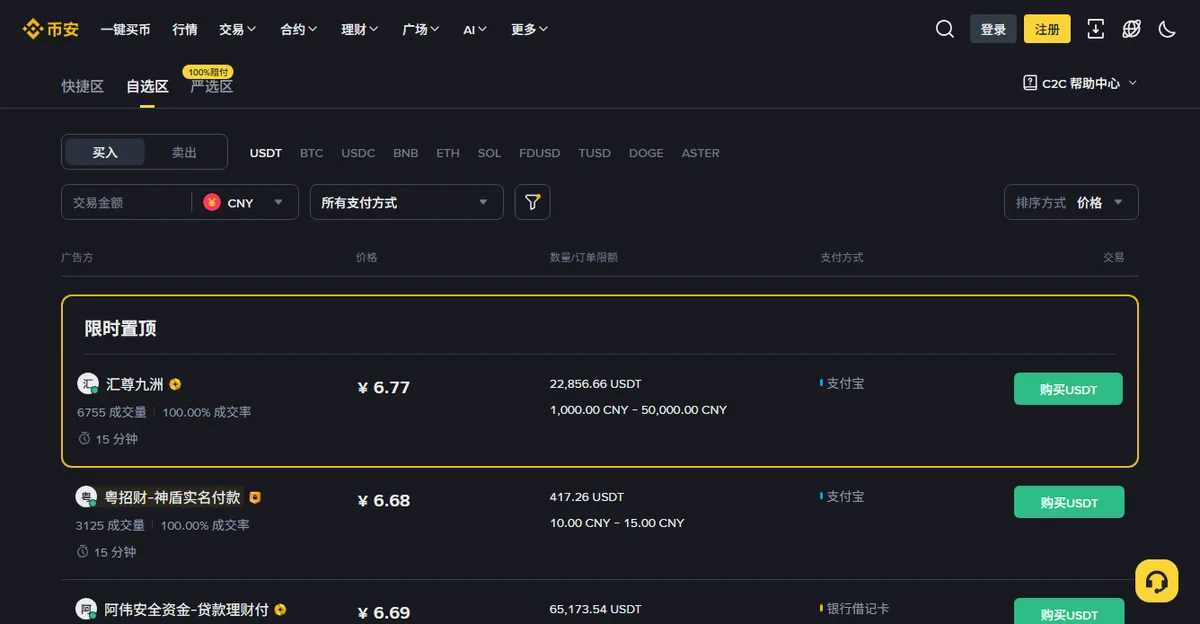
Four numbers matter, and they are usually all on the same row.
| Field | What it tells you | Rough guide |
|---|---|---|
| Completion rate | How often their orders finish rather than being cancelled | High is better; a low rate means wasted time even when nothing goes wrong |
| Order count | How much history the rating is based on | A perfect score over a handful of trades tells you very little |
| Average release time | How long they take to release the crypto after payment | Shorter is better, mostly for your nerves |
| Limits | The minimum and maximum they will trade | Your amount should sit comfortably inside, not at the edge |
Account age is worth a glance too. A merchant registered last week with excellent numbers is not necessarily a problem, but there is less to go on.
Premium is a separate cost
The gap between a merchant's price and the mid-market rate is the premium. It is not called a fee and it does not appear as one, but it is money, and as a percentage it usually dwarfs the trading fee you were worrying about.
Working it out is trivial: divide the quoted price by a reference rate and subtract one. Comparing two or three listings before you commit generally saves more than a day spent optimising fee tiers. When the market is moving or a funding route tightens, premiums widen noticeably.
What escrow is doing, and why order matters
The moment you open an order, the platform freezes the seller's crypto. They cannot move it. Then you pay. That sequence is the entire protection. It is third-party escrow, the same mechanism used in plenty of offline transactions. Pay before the order exists and none of it applies: you have sent money to a stranger on the strength of a promise, and the platform has no standing to intervene because as far as it knows, nothing happened.
There is also a clock.
Orders carry a payment window, and letting it expire cancels the order and releases the escrow. So make sure you can pay immediately before opening one, rather than opening it and then going to find your banking app.
Three ways the payment step goes wrong
The account must be in your own name
The name on the paying account has to match the verified name on your exchange account. Paying from a family member's account, or a company account, gives the merchant a legitimate reason to refuse release — they cannot show the money came from you. That is their compliance requirement, not obstructiveness.
Do not write anything sensitive in the reference field
Leave the transfer reference blank, or put something neutral in it. Banks do not publish how their payment screening reads transfer references, so there is no way to know in advance how a crypto-related word in that field will be treated. A neutral reference simply avoids the question, and if a payment does get flagged it is your account that has the problem, not theirs.
Some counterparty risk is yours and cannot be removed
This is the part most guides skip.
You cannot verify where the money you receive originally came from, and you cannot verify the chain of hands before that. Peer-to-peer transfer means moving funds with strangers; if something upstream turns out to be dirty, an investigation can reach accounts that merely handled it.
What reduces the odds: do not transact repeatedly with the same counterparty, favour merchants with long histories and high completion rates, and keep the order screenshot and the payment record for every single trade. None of that gets you to zero. It does move the probability meaningfully.
Should a large amount be split into smaller trades?
Do not pick amounts or timing according to what you think a bank's monitoring will or will not notice. Deliberately breaking a payment into pieces to stay under a review or reporting threshold is called structuring, and in some jurisdictions, the US among them, it is an offence in itself, whatever the source of the money. Buy the amount you actually need, pay from your own account, and keep the records for every order. If a trade is too large to explain to your own bank, that is a reason to reconsider the trade, not to split it.
When an order stalls
Payment sent, crypto not released. This is the situation escrow exists for.
Mark the order as paid in the platform interface. That is what starts the clock on the merchant. Wait a reasonable interval. If nothing happens, open a dispute from inside the order and attach the payment evidence: the transfer record showing amount, time, and both account names.
The one thing worth repeating: arbitration only exists because the trade happened on the platform. The escrow is still holding the crypto, which is what gives arbitration something to decide about. A transfer made outside the platform has no such backstop and no route to one.
Afterwards
What you have bought is usually a stablecoin rather than any other asset, and newly bought funds often carry a short withdrawal hold — a security delay, not a problem. Plan around it rather than being surprised by it; which currencies trigger it and how the allowance is calculated are covered in the piece on the T+1 hold.
If you are moving the crypto onward, check the address and network with the address format checker first. If you want to know what the whole round trip actually cost, including the premium, the effective fee calculator puts the layers together.
When not to use this route at all
- If your local rules restrict this kind of transaction, that is the answer. We do not publish workarounds.
- If the only account available to you is one you cannot afford to have restricted — a salary account, a mortgage account — the downside is out of proportion to the convenience.
- If someone is pressuring you to move off the platform, walk away. That pressure is the whole tell.
The receiving side has its own risk profile, which is different enough to be a separate article: selling crypto for cash.