- Convert the asset to something a counterparty will buy
- Sell it and receive money into a bank account
- Have that money stay in the account
Three stages, three different places it stalls, three different people who can unstick it. Most confusion about cashing out comes from treating it as one operation and then not knowing who to ask when it stops.
This page covers what sets the timing, which cost layers exist, how to pick the receiving account, and exactly what to ask for when a payment does not arrive.
Three stages, three stalls
Cashing out is not depositing in reverse
Putting money in is mostly about whether a route exists. Taking it out adds a question nobody asks on the way in: does the receiving institution want this particular payment.
That is the asymmetry. Deposits get validated by the platform. Withdrawals get validated by the platform and by a bank that had no part in the earlier steps and no context for them.
Check the asset is actually sellable first
Not everything has a liquid path to cash. Smaller assets often have to be converted to a major stablecoin or a major coin first, and that conversion has its own spread. Establishing the route before you need the money is much cheaper than discovering it during a market you dislike.
What decides the timing
Three segments, and only one of them is under anyone's control.
| Segment | Typically | What slows it |
|---|---|---|
| Platform processing | Minutes to hours | Security holds after a recent change, manual review, queue depth |
| Counterparty release | Minutes | An inattentive counterparty; disputes take much longer |
| Bank crediting | Same day to a few days | Cut-off times, weekends, cross-border routing over SWIFT, internal review |
What makes it visibly slower
- A recent password, two-factor or withdrawal-address change, which commonly triggers a hold measured in tens of hours.
- An amount well outside your normal pattern.
- First use of a receiving account.
- Public holidays at either end of a cross-border route.
Three layers of cost
The withdrawal fee is the layer people look at, and usually the smallest of the three.
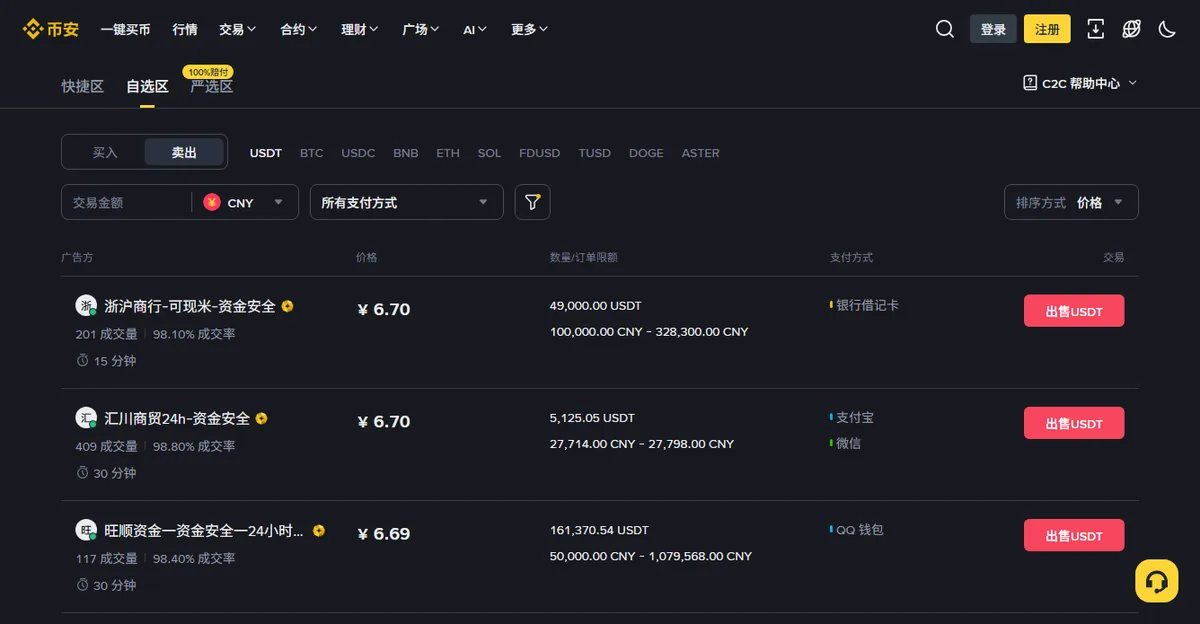
- Spread or discount when selling. Selling into a peer-to-peer book means accepting a price slightly below mid-market. In percentage terms this is normally the largest layer by some distance.
- Network fee, if the funds have to move on-chain before being sold. Depends entirely on the network chosen. See withdrawal fees by network.
- Receiving charges, which exist on some cross-border routes and are easy to forget until the credited amount is short.
One transfer or several
Splitting reduces the size of any single payment, which is sometimes useful. It also multiplies fixed fees and creates a pattern of repeated similar transfers, which is precisely the shape automated monitoring is built to notice. A single ordinary-looking transfer is usually better than five deliberately small ones.
Choosing the receiving account
The account has to be in your own name; that part is not negotiable. Beyond that, the decision is about what you can afford to have restricted.
Our own preference, stated as a preference: not the account your salary lands in and not the one your mortgage comes out of. A secondary account with a genuine history — some regular activity, not a shell opened last week purely for this — is a far more comfortable place for this to go wrong.
A brand-new account receiving a large first payment is the pattern most likely to draw a review. Both halves of that sentence matter.
Larger amounts
Do a small run first. Move a trivial amount through the entire path and confirm it arrives. This is the cheapest information you will ever buy about your own setup.
After that, spread larger amounts over time rather than over accounts, keep the amounts in proportion to the account's normal activity, and keep every record.
When it stalls
Stuck on the platform side
Status showing processing, under review, or asking for documents. Supply what is asked and wait. Repeated tickets do not accelerate it and can get them merged and re-queued. Send everything at once: transaction history, source of funds, receiving account details.
Stuck at the bank
Platform shows sent, nothing has arrived. What you need is the platform's proof of payment — normally available in the order detail — and then take it to the receiving bank. Banks act on documentation. A screenshot with text on it is not documentation.
What makes that document usable is fairly specific. It has to carry a reference the sending institution can be asked about, the exact amount, the value date, and both account identifiers. Anything missing one of those turns your enquiry into a conversation about what you remember, which no bank will act on.
Ask the receiving bank one narrow question rather than a broad one: has a credit with this reference arrived and been held, or has nothing arrived at all. Those are different failures with different owners, and staff can usually answer the narrow version immediately.
It arrived, but short
The third case, and the one nobody plans for.
Money lands, and the credited amount is less than the figure on the platform's record. Usually this is a receiving charge, an intermediary bank taking a cut on a cross-border route, or a currency conversion applied at a rate you did not choose. None of these is an error, and none will be reversed on request.
Worth doing once, before it matters: run a small amount through and compare what was sent against what was credited. The difference is the real cost of that particular route, and it is not published anywhere you can look it up.
Account restricted
First work out who imposed it — the general shape of these controls follows anti-money-laundering rules, and the FTC's guidance covers what the consumer-facing version looks like. Read the notice: if it names an investigating authority, that is a legal process. If it uses the bank's own language, it is an internal control. The two need entirely different responses, and guessing wrong wastes the time that matters most.
What to do about the receiving end more broadly — how to structure accounts and evidence before any of this happens — is in selling crypto for cash.
Plan the exit at the entrance
Work out how you would get money out before you put it in. If there is no route you can actually use, the position is illiquid regardless of what the balance says.
Treating cash-out as a rhythm rather than an event also helps: modest amounts, on a regular basis, at sizes that look like the rest of your account's activity. Keeping some money entirely outside all of this means you are never forced to cash out on a bad day.
One thing we cannot help with
There is something that has to be said plainly: tax treatment of crypto gains varies enormously by jurisdiction, this site does not provide tax advice, and we are not able to assess your situation.
The only generally useful thing we can offer: keep complete records. Whatever your local rules turn out to be, being able to show the date, amount and counterparty of each transaction beats reconstructing it from memory. That is the same evidence discipline as the rest of this page, used for a different purpose.
How to declare, whether to declare, which basis to use. Ask a qualified professional where you live. That is not modesty; it is genuinely outside what a site documenting operational steps can be responsible for.
When not to rush
- Within a security hold after changing account settings. Wait it out; contacting support does not shorten it.
- When the only account available is one you cannot afford to lose access to.
- When you are cashing out under time pressure. Rushed exits are where people accept bad prices and skip verification steps.
- The first time you use a receiving account. Send something trivial through it first — a first-use review costs you nothing if the amount is nothing.