Twenty-four hours. That is the length of the wait, and for most people it arrives as a surprise: the payment cleared, the crypto is sitting in the account, and the withdraw button does nothing.
The first reaction is usually to assume something went wrong — a failed step, a flagged account. Neither. This is a deliberate holding period the exchange applies to peer-to-peer fiat purchases. It is written up on its own help page, which almost nobody reads before placing an order.
What follows is that page, unpacked: who it applies to, how long it lasts, what you can still do while it runs, and the part most useful to readers here — why the Hong Kong dollar route largely sidesteps it.
This waiting period
What triggers it, and for how long
Two different things, often confused.
The predictable one: you buy with a fiat currency that is on the list, and part of your balance cannot be withdrawn for 24 hours. The platform calls this T+1. It clears on its own.
The unpredictable one: the risk system flags unusual account activity and every withdrawal function stops for 48 hours. That is T+2.
There is not much useful advice to give about T+2 — it is triggered by a system you cannot see. This page is about the first kind, because the first kind can be planned around.
Three points the help page states plainly, worth holding on to:
- It cannot be lifted early. Support cannot do it either.
- Trading is unaffected. Spot, futures and margin all continue; only withdrawals are held.
- P2P merchants are exempt.
The list is short, so check it
This does not apply to everyone. The help page names a specific set: a handful of fiat currencies, plus verified users in three countries.
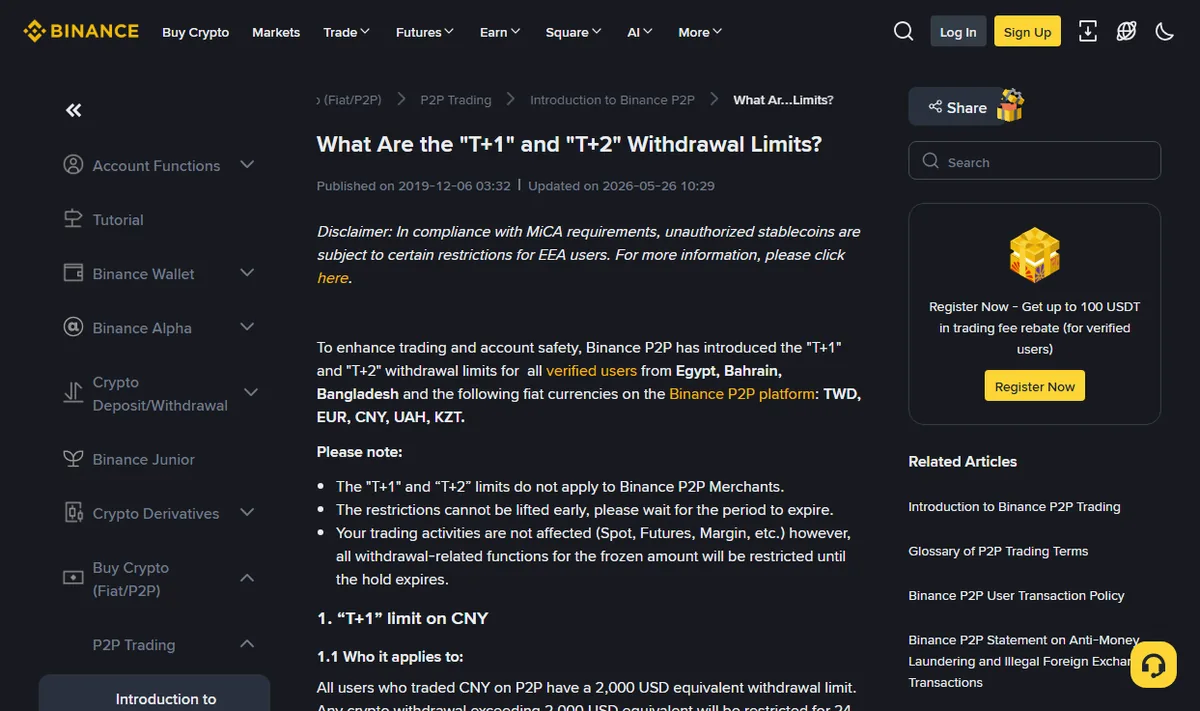
As checked in September 2026, the currencies named are the new Taiwan dollar, the euro, the yuan, the hryvnia and the tenge; verified users in Egypt, Bahrain and Bangladesh are also covered. Lists move — read the page as it stands when you are about to buy.
For readers here, one case dominates: buying with yuan on the peer-to-peer market.
The CNY rule, and the part read backwards
The mechanics are simple. The reading of them usually is not.
The platform's wording: an account that has traded yuan on the peer-to-peer market carries a withdrawable allowance of roughly 2,000 US dollars equivalent. Anything up to that goes out immediately; anything above it is held for 24 hours and then released automatically. (That figure was checked in September 2026 and the platform adjusts it — trust your own account page.)
Here is the part people get backwards: what is held is the amount above the allowance, not the coins you just bought.
The platform's own worked example makes it clear. You already hold 5,000 USDC, then buy one bitcoin with yuan. The withdrawable allowance is the line; whatever sits above it is held. It is not "the new bitcoin is frozen and the older USDC is free."
So "I'm withdrawing coins I had before, that should be fine" does not hold. The system works from your account total against the allowance, not from when each coin arrived.
Why HKD is not on the list
We described the Hong Kong dollar route as the smoother of the two. This rule is one concrete part of what "smoother" means: as checked in September 2026, HKD does not appear on this list.
Two qualifications, before that gets carried away as a conclusion.
First, absent today does not mean absent forever. These lists are adjusted by regional risk, without notice.
Second, it does not make that route carefree. It has its own sensitivities — what you write in the payment reference, whether the account has ordinary traffic — covered in that piece, and unrelated to this hold.
Where we land: if you already hold a Hong Kong account, the buy-and-move-immediately case really is easier. Opening one purely to dodge a 24-hour wait is not worth it — the cost and friction of setting one up and keeping it alive far exceed waiting a day.
What still works while it runs
More than most people assume.
| Still available | Not available |
|---|---|
| Spot trading | Withdrawing the held portion on-chain |
| Futures and margin | Moving funds back to the funding account once out |
| On-platform earn products | Asking support for an early release |
Put differently: if you bought in order to do something on the platform, this barely touches you. The people it actually blocks are the ones who bought in order to move the coins somewhere else — to a private wallet, to another venue, or to someone else.
Anyone offering to unlock it early is lying
The help page states the hold cannot be lifted early. Anyone claiming a channel, or a fee that releases it now, is after either a transfer or your account details. The patterns in the piece on receiving payments apply here without modification.
Planning around it
There is no trick, only scheduling. Three things:
- Buy a day early. The cheapest fix by far. If you know the date you need the funds, buy the day before and the allowance has long since reopened.
- Know which fiat currency you are using. Same platform, same peer-to-peer market, different currency, different rule.
- Split large amounts by purpose, not to evade. The allowance is calculated per account, so splitting orders does not shrink what gets held. What does help is separating "needs to move today" from "can sit for a while", and keeping the first within the allowance.
Which brings back a line left hanging in the piece on buying with yuan: the purchase is only the first half of this route. Whether the money moves when you want it to depends on the second half. Cashing out covers getting it back to a bank; this covers the stretch where it sits still inside the platform.
Platform rules change. Every figure here was checked in September 2026 — when it matters, read what is on your own screen. If something no longer matches, tell us and the change goes into the corrections log.
So the question worth asking before you place the order: which day, exactly, do you intend to move this money?