Binance keeps a document called the List of Prohibited Countries. The version dated 5 January 2026 names nine places: the United States; Canada and the Netherlands; Cuba, North Korea, Iran, Crimea, and the so-called Donetsk and Luhansk People's Republics. If you have the kind of link to one of them that the list describes, you are not eligible to open an account.
That is only part of the answer, though. The list is split into three groups, and the US group reaches further than the others: it also covers citizenship. And a country can be missing from the list and still be closed to you, for reasons the list never mentions. Below is the list read line by line, followed by the two other eligibility checks that sit outside it.
Before you read the list
- Where the list lives and how to tell which version you are reading
- Three groups, three different reaches
- Why mainland China is not on the list
- Syria: where the list and the terms disagree
- Not on the list, but not every product either
- Why "supported countries" lists online contradict each other
- A five-step check before you sign up
Where the list lives and how to tell which version you are reading
You reach it from the Terms of Use. Clause 2.1 sets out the eligibility criteria, and item (g) says you must not be located, incorporated or established in, be a citizen or resident of, or operate in two kinds of place. The second kind is any country on the List of Prohibited Countries, and those words link to the list itself.
The list opens as a one-page PDF embedded in the site. The line that matters first is Updated, just under the title. Do not confuse it with the date at the top of the Terms of Use, which still reads 31 August 2023. The list is revised on its own schedule, so the two dates move independently.
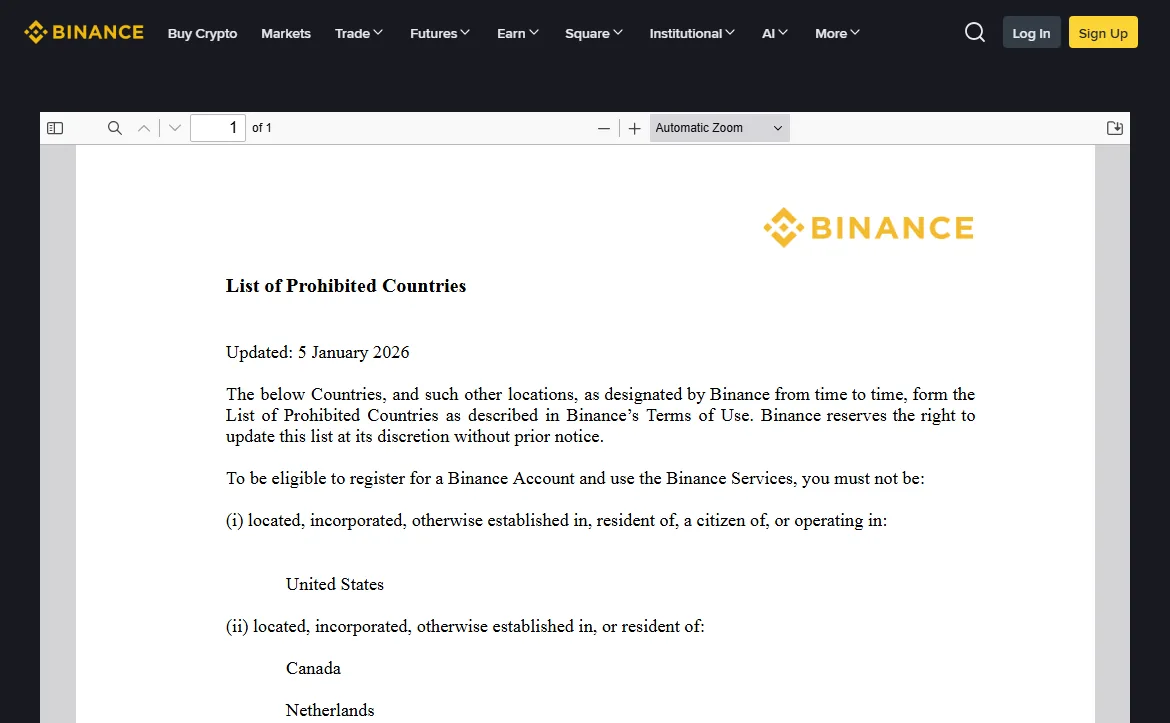
One sentence near the top is easy to skim past: the list is made up of the countries named "and such other locations, as designated by Binance from time to time". The nine lines in the PDF are what has been written down. They are not promised to be everything.
Three groups, three different reaches
The place names differ from group to group, but the more important difference is in the sentence that introduces each one. That sentence decides which kind of connection to the place gets you excluded.
| Group | Places named | Connections covered, in the list's words | Who this catches that the others do not |
|---|---|---|---|
| (i) | United States | located, incorporated, otherwise established in, resident of, a citizen of, or operating in | A US citizen who lives and is based somewhere else |
| (ii) | Canada, Netherlands | located, incorporated, otherwise established in, or resident of | None (citizenship is not in the wording) |
| (iii) | Cuba, North Korea, Iran, Crimea, the so-called Donetsk and Luhansk People's Republics | located, incorporated, otherwise established in, or resident of | None (citizenship is not in the wording) |
Group (i) is the broadest. Suppose you live in Singapore, hold a Singapore ID and also hold a US passport. By this wording you are still excluded, wherever you happen to live.
Groups (ii) and (iii) stop at "resident of". Read on its own, the list does not catch a Canadian citizen who lives elsewhere. But clause 2.1(g) of the Terms applies citizenship and residence to the whole list, without splitting it into groups. When two official documents use different wording, it is safer to go by the broader one. If you hold a passport from a group (ii) or (iii) country, ask support in writing before you register and keep the reply.
Crimea, Donetsk and Luhansk each carry a reference to a US Executive Order (13685 and 14065), which sets the geographic boundaries. Like Cuba, North Korea and Iran, they are on the list because of sanctions, not licensing.
The last paragraph of the PDF is about companies: there are many ways a company can be connected to the United States, and Binance links to a separate page explaining how it decides whether a company counts as a US user. An individual signing up for themselves can skip it.
Why mainland China is not on the list
Because the list is only one of the checks. Clause 2.1(g) actually covers two kinds of place. The list is the second. The first names no countries at all: it covers any jurisdiction where your access to or use of Binance would break the law that applies there, or cause Binance or anyone else to break it.
For that first kind, local law decides, not anything Binance publishes. Mainland China is the obvious example. On 6 February 2026 the People's Bank of China and seven other authorities issued a notice on virtual currency risks (Yinfa [2026] No. 42); the full text is published on the China Securities Regulatory Commission website (opened October 2026). The notice treats crypto business activity inside the mainland as illegal financial activity, and states that overseas entities and individuals may not illegally provide crypto-related services to people or entities inside the mainland in any form. It also repealed the 2021 notice on the same subject (Yinfa [2021] No. 237).
So China's absence from the PDF tells you nothing about whether you can use the service from there. In our eligibility check, mainland China is marked as not open.
The same logic applies to every country the list leaves out. Not being named only means Binance has not written that country into this document. Whether local law bans the activity, or requires a licence, is a separate question for that country's regulator.
Syria: where the list and the terms disagree
Syria is not on the 5 January 2026 list. Clause 26 of the Terms of Use, the list of prohibited uses, still contains item (q): you agree not to access or use Binance services in a jurisdiction Binance considers high-risk, and it names Cuba, Iran, North Korea and Syria as examples.
The two documents were last updated more than two years apart, and the Terms have not caught up. Do not read Syria's absence from the list as permission. If you have a connection to Syria, get a written answer from support before you go further.
This mismatch is also a quick way to judge a third-party article. If it still lists Syria next to Cuba, Iran and North Korea, and gives no version date for the list, it is either working from the Terms or from an older copy of the list.
Not on the list, but not every product either
Passing the eligibility check does not mean every product is open to you. Clause 20.5 is direct about it: residents of some countries may only be able to access some, not all, Binance services, and the services offered to you can change. Futures, Earn products or a particular fiat payment route can be switched off in a country while the account itself keeps working. None of that shows up on the prohibited list.
The same clause has two more lines about where you physically are:
- If you travel to a country on the list, you may be unable to use the service or be blocked, which affects trading and your ability to watch open orders and positions. Factor this in before a trip.
- You may not try to get around these restrictions, and the example the clause gives is using a VPN to change your IP address.
Two other clauses tend to come up with location questions. Clause 2.1(f) requires that you do not already have a Binance account: one person, one account. Clause 2.2 lets Binance change the eligibility criteria at any time, sometimes without notice. Being able to register today is not a permanent answer.
Why "supported countries" lists online contradict each other
Search for which countries cannot use Binance and much of what ranks is user posts and third-party roundups that disagree with each other. Most of the disagreement traces back to three mistakes:
- Treating "licensed in" as "can register from". A local Binance entity or licence means business there runs through that entity. A country without one is not automatically on the prohibited list either. They are different tables.
- Old versions. The list changes, and the January 2026 version is not the one that circulated a year or two ago. Syria is the obvious example.
- Offering workarounds as answers. Some posts suggest picking a different country of residence at sign-up. That breaks the eligibility criteria in clause 2.1, and it clashes with clause 27(a), where you promise that everything you submit is true, accurate and complete. The consequences tend to arrive at withdrawal time, not at sign-up.
How to fill in the country field itself is covered in choosing your country at sign-up.
A five-step check before you sign up
- Open the Terms of Use, follow the link to the List of Prohibited Countries, check the Updated date, then find which group (if any) your country falls into.
- Separate out your connections: where you are right now, where you normally live, and every citizenship you hold. For the US group, citizenship counts on its own.
- If your country is not listed, look up what your local law and regulator say. Mainland China is covered above.
- Check the specific products you want (futures, Earn, a given fiat deposit method) separately. Eligibility does not mean all of them are open.
- If anything is unclear, open a written ticket with support. Do it before you deposit, not after.
Once that is done, the sign-up guide walks through the actual steps, and the verification checklist helps you prepare documents. What this page summarises is Binance's published documents. It is not legal advice, and whether something is lawful for you depends on local law. The limits of what this site covers are set out in the risk notice.