Say you hold some USDT on Binance and want it back as Hong Kong dollars, landing in a bank account in your own name. There are three realistic ways to do it: sell to a merchant on Binance P2P, move the coins to a platform licensed by Hong Kong's Securities and Futures Commission and sell there, or use a money-changer shop or OTC desk. Fees and speed differ, but the thing that actually separates them is simpler: whose account the Hong Kong dollars come from when they reach yours.
On P2P the money comes from a buyer you have never met. On a licensed platform it comes from the platform's own account. At a shop it is usually cash. Your bank sees that one incoming payment, and if something goes wrong, that payment is what you will be asked to explain. The rest of this page follows that thread.
Six parts
Route one: selling to a P2P merchant
This is the obvious first option, because the coins are already on Binance. The mechanism is the buy flow in reverse: you take a sell order, your USDT is locked in the platform's escrow, the buyer sends HKD to your account, and you release the coins once the money is really there.
- Move the USDT into your Funding wallet. P2P trades draw on that balance, so coins sitting in Spot need a transfer first.
- Add a payment method in your own name. On HKD sell ads the payment column mostly shows "Instant Transfer" and "Bank Transfer". Instant Transfer is how the page labels FPS.
- Type your amount into the "Transaction amount" box before browsing. Skip this and you will likely click the first ad, only to find your amount is under its minimum.
- Wait for payment, confirm it has arrived, then release. Release cannot be undone, which is why it gets its own section below.
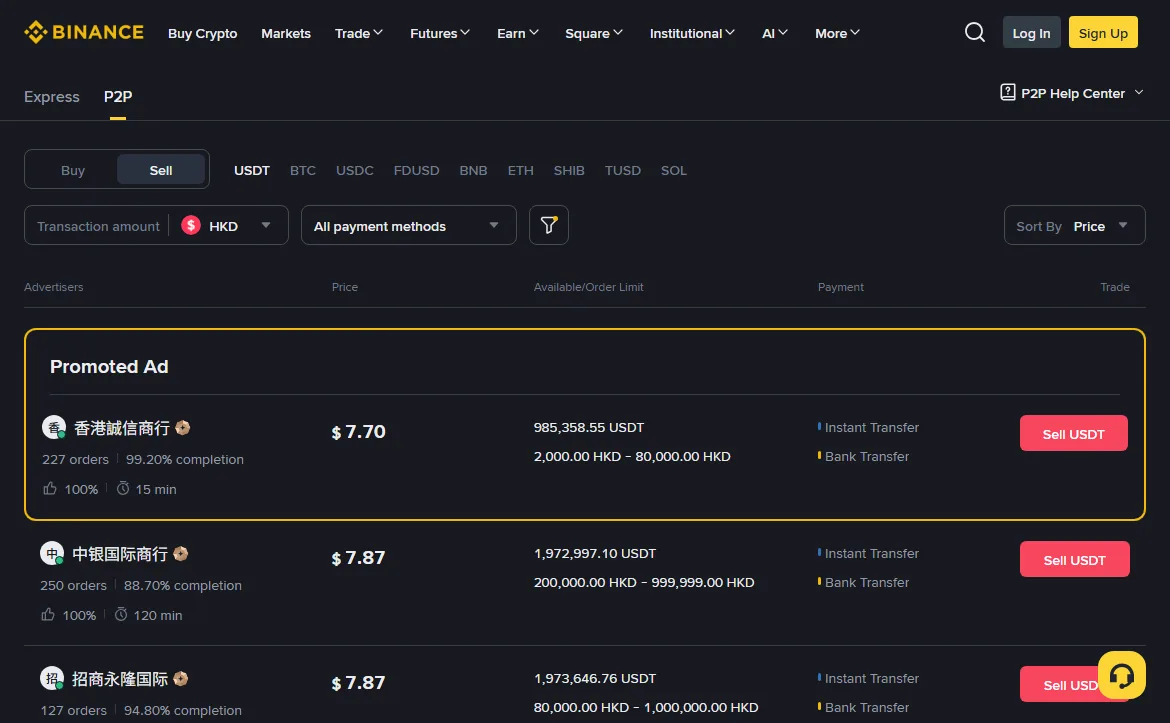
Of the three ads at the top of the capture, only the promoted one accepted orders under HK$80,000; the other two had minimums of HK$200,000 and HK$80,000. The smaller your amount, the fewer counterparties you get, and usually the worse the price. A sale of a few thousand dollars means paging further down or accepting something like the promoted quote. The list shifts daily; entering the amount first stays the right habit.
Check the sell price against the peg
The Hong Kong dollar is pegged to the US dollar: the HKMA keeps it between 7.75 and 7.85 per US dollar, and USDT tracks the US dollar. That gives HKD quotes a reference point most currencies lack: one USDT should normally fetch something close to that band. Where the band comes from is covered in the FPS buying guide; here is how it works on the sell side.
When buying, a high quote hurts. When selling, a low one does. In the screenshot the promoted ad offers 7.70, below the bottom of the band, while the next two offer 7.87. On 10,000 USDT:
- at 7.87 you receive HK$78,700;
- at 7.70 you receive HK$77,000;
- the HK$1,700 gap is roughly 2.2%, far more than any exchange fee tier.
"Promoted Ad" is a paid slot, not a price ranking. Its low minimum genuinely helps small sellers; just know what that convenience costs. To put the spread and your other costs into one percentage, use the premium field in the effective fee calculator.
Four checks before you release
On the selling side, one action matters more than any other. Once the coins are released they are gone, and you have no idea where the buyer's money came from. Before pressing release:
- See the credit in your online banking or bank app. A screenshot in the chat or a "paid" text message is not a credit.
- The payer's name must match the buyer's verified name on the order. A different name means a third-party payment. Do not release, and do not refund it yourself either; open an appeal on the platform so the coins stay in escrow.
- The amount is exact and arrives as one payment. Several transfers from different accounts get the same treatment as a third-party payment.
- Run the paying account through Scameter. It is a public search tool on the Hong Kong Police's CyberDefender site where you can enter a receiving account, phone number, URL and similar details to see whether they have been reported. The page says you can leave the type unselected if you are unsure. No record does not prove the account is clean; a hit is reason enough to stop. It lives at cyberdefender.hk/scameter (the page opens in traditional Chinese).
If a buyer pushes you to hurry, suggests settling "off platform because it is faster", or asks you to put specific words in the transfer note, there is nothing to weigh: keep everything inside the platform. The full receiving-side playbook, from arranging accounts to keeping evidence and what to do in what order if trouble starts, is in selling crypto for cash: lowering the freeze risk.
Route two: through an SFC-licensed platform
If you would rather not have a stranger's money land in your account, you can send the USDT to a virtual asset trading platform licensed by the SFC, sell it for HKD there, and withdraw to your own bank account. The credit then comes from the platform, and the counterparty on your statement is a regulated company.
Which platforms count as licensed is answered by one source only: the SFC's own lists of virtual asset trading platforms. In September 2026 the licensed list had 13 names, the earliest being OSL (licensed December 2020) and HashKey Exchange (November 2022). The same page carries an applicants list, and the SFC is blunt about it: applicants on that list are not licensed, including those that are "deemed to be licensed". Binance appears on neither list.
The price of this route is time and an extra layer of fees:
- You open and verify a new account. On a first run, most of the waiting happens here, not in the transfer.
- Confirm the platform accepts USDT and on which network. Support differs between platforms, so check their deposit page first, then run the address through the address format checker. What a wrong network costs, and how withdrawal fees differ by chain, is in the withdrawal fee guide.
- Fees come in three pieces: Binance's withdrawal fee, the platform's trading fee, and whatever it charges to send HKD to your bank. The last two are on each platform's own fee page; we have not checked them platform by platform.
For larger sums, or when the account also takes your salary and pays your rent, a few extra days buys you a clean, traceable credit. For small, occasional amounts, route one with the four checks above is workable. Both choices are defensible; what decides it is how much you lose if that particular account gets frozen.
Route three: shops and OTC desks
Hong Kong has physical money changers and OTC counters that swap USDT for cash, and searching the topic turns up plenty of guides to them. We only flag two things here and do not walk through the process.
First, there is no escrow. You send the coins, they hand over cash, and no platform holds anything in between or hears an appeal. Second, the cash still has to reach a bank. A large cash deposit comes with a counter receipt at best, which is the thinnest trail of the three routes if anyone asks later. We did not find a regulatory provision in force that we could cite directly for these counters, so we make no judgement about any particular shop.
| Route | Whose account the HKD comes from | Anyone holding the coins in between? | Extra setup the first time |
|---|---|---|---|
| P2P merchant | The buyer (it should be) | Yes, platform escrow until you release | A payment method in your name; the four release checks |
| SFC-licensed platform | The platform's own account | Not needed: you sell to the platform itself | New account and verification; confirm the deposit network |
| Shop or OTC desk | Usually cash, which you then deposit | No | Not reviewed by us; no how-to given |
After the money lands: the bank and the law
The Hong Kong Monetary Authority's page "Don't Lend/Sell Your Account" says never to sell or lend your account: it may be controlled and used for unlawful purposes, which makes you liable for money laundering, with a maximum penalty of 14 years in prison and a HK$5 million fine.
Here is why that matters when selling USDT. The person paying you on P2P may be moving stolen money through someone else's account. You received it as payment in a real trade, but to the bank and the police your account still sits on that chain of transfers. The only thing that speaks for you is the record you kept at the time.
Keep these for every cash-out
The P2P order number and a screenshot of the order page (buyer's verified name, amount, time); the full in-platform chat; the matching line on your bank statement; and, if you checked Scameter, a screenshot of the result at that moment. On a licensed platform, keep its trade and withdrawal records.
You will rarely need them. When a bank or the police ask, they decide how long the explaining takes.
Two more things can get an account in trouble regardless of platform: do not receive money on someone else's behalf, not for a friend and not for a small fee; and do not lend your account, online banking or FPS ID to anyone. That is exactly the situation the HKMA page describes.
The renminbi side works differently and fails in different places; see cashing out USDT. Whether your account can use the HKD channel at all depends on its region setting, covered in choosing your country at sign-up. On a first cash-out, keep the amount small enough that a few weeks of frozen access would not disrupt your life. That matters more than finding the best quote.