| Layer | Direction | Called a fee? |
|---|---|---|
| Maker or taker | Sets the starting rate | Yes |
| Tier level | Reduces it | Yes |
| Platform token discount | Reduces it | Yes |
| Referral rebate | Reduces it | Yes |
| Purchase premium | Increases your real cost | No |
| Funding rate | Increases it, per interval | No |
| Bid-ask spread | Increases it, every trade | No |
Four things reduce the number. Three things increase your real cost without ever appearing under the word "fee". That asymmetry is why people who optimise their fee tier are sometimes paying more than people who did not bother.
Where the money actually goes
Which rate are you actually looking at
The figure on a fee page is a starting point for a specific product at a specific tier. Before it means anything to you, you need to know which product line it describes and which tier you are in.
Why there is no fee table on this site
Because it would be wrong, and being wrong here is worse than being absent. Rates move with tier, with promotions, with product line and with policy. A table published today becomes misinformation on a schedule nobody controls, and unlike a vague statement, a precise number gets used for calculations.
So this page explains the structure, points at the platform's own published fee schedule for the current figure, and gives you a calculator to combine them yourself. That is a deliberate trade: less convenient, considerably harder to make wrong. The structure here was first put together in August 2026 and read against the schedule page again in September 2026: tiers still key off a combination of 30-day volume and platform-token balance, and the first tier above a regular account still sits at millions of dollars of volume. The framing held. The numbers inside it move whenever the platform decides they do.
Derivatives run on a different schedule
Worth stating separately because it catches people out: spot and futures do not share a fee schedule. The rates differ, the tier thresholds differ, and a discount that applies to one may not apply to the other. Reading a spot rate and assuming it covers your futures trading is a common and expensive mistake.
The four layers multiply
They do not add. Each applies to what is left after the previous one, which is why intuition about "20% plus 25%" gives the wrong answer — two reductions of 20% leave you paying 64% of the base rate, not 60%.
The order does not matter. The starting rate does.
Worth clearing up, because people ask it a lot: applying the token discount before the referral reduction gives exactly the same answer as the other way round. Multiplication does not care about order.
What does change the answer is which number you start from. Take the taker rate when you mostly place limit orders, or the entry-tier rate when your account sits a tier above, and every layer below inherits that mistake. The multipliers are the easy part; picking the right base is where the error usually is.
Maker and taker
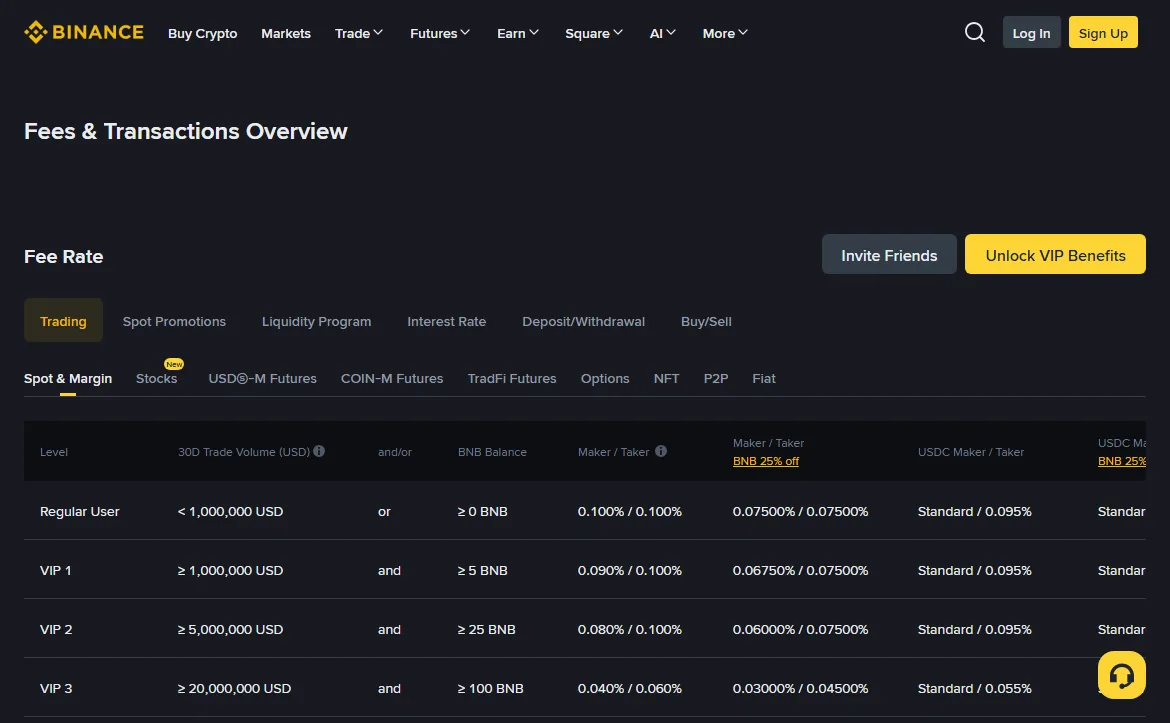
A taker order removes liquidity from the order book. It matches something already sitting there. A maker order adds liquidity and waits, which is the retail version of what a market maker does. Maker rates are lower — but only once you sit high enough up the table for that to be true.
That qualifier carries more weight than it sounds like, because at the entry tier it is not true at all. We read the published spot schedule again on 17 September 2026: in the entry row, the maker rate and the taker rate are the same number. The maker column only drops below the taker column from the first VIP fee tier upward. So whether posting rather than taking saves you anything depends entirely on which fee tier you are in — and in the tier where most accounts sit, it saves nothing on the rate.
That does not make limit orders pointless. It moves what they are worth. The real cost of a market order is slippage and the spread, neither of which is ever called a fee, and both of which come straight out of your fill price. That saving is still there for an ordinary account. It is a saving on the price you get, not on the rate you are charged.
Being a maker on purpose
Use limit orders rather than market orders, and place them where they will not fill instantly. If your limit price crosses the current book, the order executes immediately as a taker and you have paid the higher rate while believing you did not.
The trade-off is real: a maker order might not fill. In a fast market, waiting for a better fill and missing the trade entirely is not a saving. Where getting in matters more than the price, cross the spread and move on.
Tier level: what a VIP fee tier actually changes
Fee tiers are set by rolling 30-day volume and platform-token holdings. For most people the thresholds are simply out of reach, and there is no strategy that changes that — trading more to reach a discount costs more than the discount returns.
One detail is easy to read past. At the entry tier the two conditions are joined by "or", which is why every account starts there. From the first VIP fee tier upward they are joined by "and": volume and token balance both have to clear the bar, and missing either one keeps you where you are.
Two more things worth knowing before you work out how close you are. Volume is counted more broadly than just spot orders — margin, convert, copy trading and trading bots normally feed the same figure, and block trades can count at a multiple — so your real number may be higher than you assume. And a tier, once reached, generally applies across the platform's product lines, rather than having to be earned again in each market.
Where it is worth attention: if you are already close to a threshold through normal activity, knowing where the boundary sits is useful. Otherwise, ignore this layer — with one exception. Your fee tier is what decides whether the maker discount described in the section above exists for you at all.
The platform token discount
Holding the platform's token and enabling fee deduction cuts the rate by a set proportion. Straightforward, and usually worth doing.
Two situations where it is not, and this is our own view rather than a rule:
- You do not want the token. Enabling the discount means holding a volatile asset to save a percentage on fees. If its price falls further than the fees you saved, you lost money doing something described as saving money.
- You trade rarely. The saving scales with volume. At low volume the exposure outweighs the benefit, and you have added a position you were not trying to take.
The referral layer
An account created with a referral code is eligible for a further reduction, commonly quoted with a ceiling around 20%. Note "up to": the actual share is set by the current promotion, differs by product line, and is whatever your own fee page shows once you are logged in.
The catch is one of timing rather than value. The code can generally only be entered during sign-up and cannot be added afterwards, covered in detail in referral code missed at sign-up.
Only works during sign-up, in the field you have to expand before it appears.
If you have not opened an account yet and want to use it, this entry point already carries the code: go to the Binance sign-up page. To be clear: that link carries our referral parameter. Signing up through it costs you nothing extra. The mechanics are set out on our disclosure page.
Registering directly without any code is equally fine and nothing here is withheld from you. You give up the reduction; that is the whole difference.
Confirming the layer is active
Check your own fee page after logging in. It shows the rate actually being applied, with the reductions already included. That page is the answer for your account; everything on this one is a description of the mechanism.
When chasing a tier stops paying for itself
There is a break-even here, and it is easy to work out.
A tier upgrade saves you the rate difference on every future trade. Reaching it early costs you the fees on whatever extra volume you traded purely to get there. So the question is whether the volume you would have traded anyway already carries you over the threshold. If it does, the upgrade is free and worth knowing about. If it does not, you are paying full rate on the extra volume to save a fraction of a rate on the rest — which almost never nets out.
Put concretely: trading an extra unit of volume to reach a discount saves you a small percentage of a small percentage. It is a rounding error dressed as a strategy, and it is the single most common way people talk themselves into overtrading.
Three costs that are never called fees
These are where the money mostly goes.
Premium when you buy
Acquiring crypto through a peer-to-peer route means paying above the mid-market rate. That gap is a real cost, it is frequently larger as a percentage than any trading fee, and it appears nowhere in your fee summary. It also widens when markets move or funding routes tighten. See buying USDT through P2P.
Funding on perpetual positions
Perpetual contracts exchange a funding payment between long and short holders at regular intervals. Hold a position across many intervals and this accumulates independently of whether the price moved. For anything held longer than a few days it routinely exceeds the trading fee by a wide margin. The funding rate converter turns a per-interval rate into a holding cost.
The spread
The gap between the best bid and the best ask is paid on every round trip, whether or not anyone calls it a cost. On liquid pairs it is negligible. The BIS has published work on how much it widens when liquidity thins. On thin ones it can dominate everything else on this page.
What a round trip actually costs
Individually each of these looks small. Put one full circuit end to end and the shape of the bill changes.
Say you acquire crypto peer to peer, trade it once, and cash out. You pay a premium on the way in. You pay a trading fee to enter and another to exit, both after whatever discounts you have. You cross the spread on both legs. If the asset moves on-chain at any point you pay a network fee. And if you were holding a perpetual rather than spot, funding accrued for every interval the position was open.
Seven line items, of which the discount stack touches two.
This is the arithmetic worth doing once, on your own numbers, before deciding whether the fee tier is the thing to optimise. For most people who trade occasionally and buy peer to peer, the premium alone is larger than the entire trading fee on both legs. The effective fee calculator will fold the premium in alongside the discounts so you can see the two side by side rather than guessing which dominates.
Withdrawal fees belong to the network
Withdrawal cost is set by the network you select, not by the exchange, and the same asset can differ by an order of magnitude across networks. The mechanics are documented by the networks themselves: ethereum.org explains the gas model, and TRON's resource model explains the bandwidth-and-energy model that works quite differently.
Confirm the receiving side supports the network before choosing it. A withdrawal sent on a network the destination does not support is generally unrecoverable, and no fee saving survives that. Full treatment in withdrawal fees by network.
Work it out rather than remembering a number
Take your current rate from your own fee page, apply the layers that actually apply to you, and add the three that never show up as fees. That is your cost. It is not a number anyone else can tell you, and it is not stable enough to memorise.
The effective fee calculator does the multiplication. It has no fee rates built in, deliberately — everything comes from what you enter, because a stored rate would be wrong by the time you used it.
Before optimising fees, get the size right
Leveraged and perpetual products can lose your entire margin in a short space of time, and losses can exceed what you expected. This page is about cost structure, not a suggestion to use those products. If you are going to, read the risk notice first.