| Spot | Futures | |
|---|---|---|
| What you hold | The asset itself | A contract referencing its price |
| Cost of holding | None | Funding, at every interval |
| Maximum loss | What you put in | Your margin, and faster |
| Forced closure | Does not exist | Liquidation, without asking you |
| Time | Neutral | Working against you |
The row that matters most is the last one, and it is the one beginners discover late.
The two, side by side
What you are actually buying
Spot is ownership. You buy the asset, you have it, you can move it off the platform. Nothing happens unless you act.
Futures. A perpetual, in the usual case. Is a contract whose value tracks a price. You never hold the underlying asset. The position exists inside the platform, has ongoing obligations attached, and can be closed by the system without your involvement.
"Futures fees are lower" — what that actually means
The headline rate on futures often is lower, and quoting that as a reason to prefer futures is comparing one line of a bill while ignoring the rest.
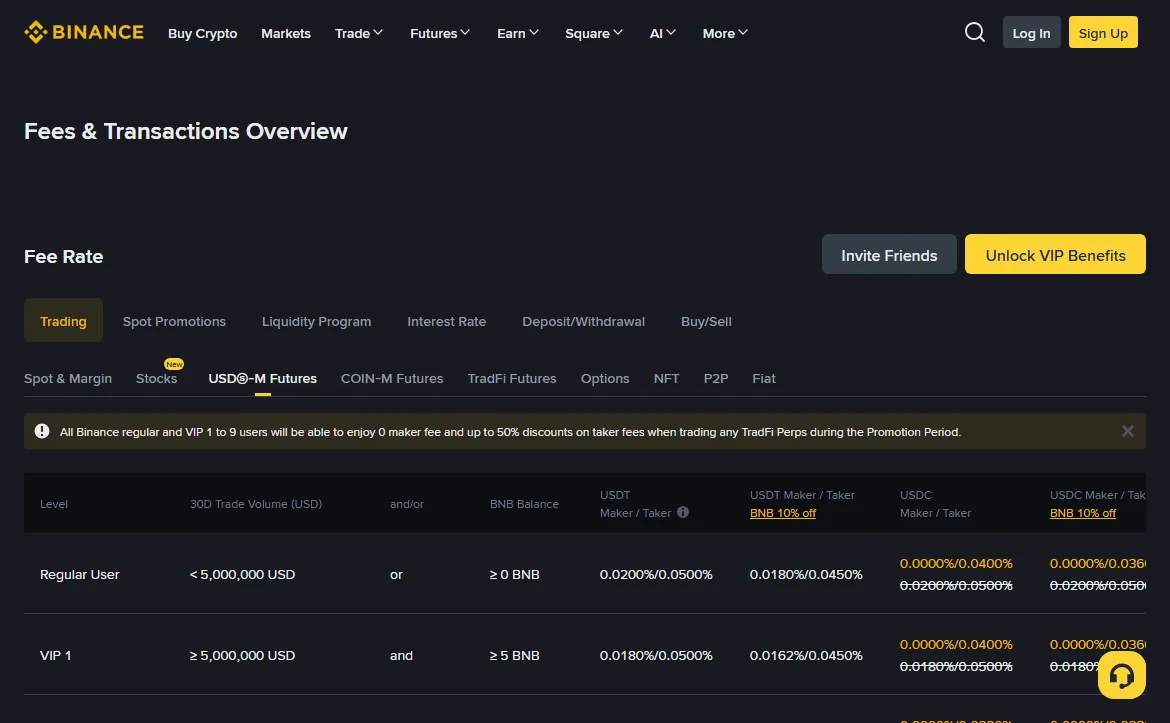
The mechanism in this section was read against the futures tab of the fee page in September 2026: the two product lines carry separate tables and separate tier thresholds, and a discount on one does not necessarily reach the other. What was checked is the structure. The numbers inside it are the platform's to change.
Futures positions pay or receive funding at regular intervals for as long as they are open. Hold across enough intervals and that dwarfs the trading fee. Spot has no equivalent. Buy and hold for a year, and holding cost you nothing at all.
Liquidation: the door only futures has
A futures position carries a maintenance margin requirement. If price moves against you far enough that your margin falls below it, the system closes the position. It does not need your agreement and it will not wait for you to add funds.
Spot has no equivalent mechanism. A spot position that halves is worth half. A futures position that moves against you by much less than half can be gone entirely.
Which side time is on
Buy spot and wait. Nothing accrues. The position costs the same to hold on day one and day four hundred.
A futures position is accumulating cost the whole time, while price volatility works on your margin. Time is charging you.
This is starkest in a flat market. Spot simply is not making money. Futures is bleeding.
What a leverage multiple really means
Higher leverage does not mean bigger profits. It means a smaller adverse move wipes you out. Those are the same statement, and only one of them gets said out loud.
Put differently: the higher the multiple, the larger the proportion of your margin consumed by the same price movement. That is arithmetic, not probability.
Turning the multiple into a price move
The useful version of this is a number you can work out before opening anything.
Divide one by the leverage multiple and you get, roughly, the adverse move that wipes out your margin. At 10× that is a 10% move against you. At 25× it is 4%. At 100× it is 1% — and a 1% move is an ordinary hour in this asset class, not an event.
The real figure is slightly worse than that, because liquidation triggers when your margin falls below the maintenance requirement rather than when it reaches zero, and fees and funding come out along the way. So treat the division as an optimistic ceiling. If the answer is a move you have watched happen while making a cup of tea, the multiple is too high regardless of how confident you are about direction.
Why this catches beginners specifically
There is a psychological trap layered on top. High leverage means a small deposit controls a large position, which makes it easy to underestimate what you are exposed to. Your risk is measured by the notional size of the position, not by the margin you posted.
The funding rate converter makes the holding cost concrete, which is usually more sobering than any warning.
Cross or isolated
- Isolated. Each position's margin stands alone. If it is liquidated, the loss stops there and the rest of the account is untouched.
- Cross. The account backs the position. It survives larger moves, and takes more with it when it does not.
Adding margin is a decision, not a reflex
Topping up a position that is about to be liquidated feels like the obvious move. What it actually is: increasing your commitment to a direction that has so far been wrong.
This is not to say never. It is to say ask one question first. If you held no position right now, would you open this one at the current price? If the answer is no, adding margin only delays the outcome while enlarging it.
Four things people repeat
"Futures let me hedge my spot holdings"
True in principle and demanding in practice. A hedge needs correct sizing, ongoing management, and the funding cost accounted for. Done casually it produces two positions that lose money in different ways.
"I'll just try a small amount"
Small amounts do limit losses, which is genuinely true. Be clear about what a small trial teaches you: the interface and the mechanics. It cannot teach you how you behave under pressure, because there is none. People stay calm with trivial sums and behave completely differently when the amount matters — and that is exactly when judgement needs to be good.
"A stop-loss makes it safe"
A stop-loss caps a normal loss. In a fast market, orders fill below the stop price. It is a useful tool and not a guarantee, and treating it as a guarantee is how people size positions they cannot afford.
"I'll make it back"
Arithmetically, no. Lose half and you need to double to return to where you started. The larger the loss, the more disproportionate the recovery required. Which is why limiting the size of any single loss matters more than chasing any single gain.
Spot has hidden costs too
Not an argument for futures. An argument for comparing like with like.
Spot costs include the premium paid when acquiring crypto in the first place, the bid-ask spread on both legs, and withdrawal fees if the asset moves. On thin pairs those add up to more than people assume.
The point is that cost comparisons have to cover the same scope. Comparing a futures trading fee against a spot trading fee, and stopping there, can produce a conclusion that is backwards. How to put the layers together is in how fees stack.
If you just want to lose less when prices fall
This is the honest reason most beginners look at futures, so it deserves a direct answer: holding less is the simple version, and it has no funding cost, no liquidation, and no timing requirement.
Shorting to protect a spot position is a real technique that requires you to be right about direction, size and timing simultaneously. The simple version requires being right about none of them.
A way to decide
Three questions, answered honestly:
- Can you state what your position costs to hold for a week? If not, you are not ready to hold one for a week.
- Would a total loss of this margin change anything about your life? If yes, the size is wrong regardless of the product.
- Are you using leverage to express a view, or to make a position feel affordable that otherwise would not be? The second one is where the trouble starts.
If you are going to try it anyway
Then: isolated margin, the lowest multiple the platform offers, a position size you could lose entirely without it mattering, and the funding cost calculated before you open rather than discovered afterwards.
The part that is not optional
Leveraged and perpetual products can consume your entire margin in a short space of time, and losses can exceed what you anticipated. This is not an edge case — it is how the product behaves normally. Read the risk notice before deciding.